BYD Yangwang U7: 1,287 HP EV Specs & 1,006 km Range
Published on: March 23, 2026
Author: Myo Satt
Estimated read time: 5 minutes
Don't have time to read the article? Listen to it in audio form instead.

Starting at 320,000 AED
The BYD Yangwang U7 walks into the ultra-luxury EV segment with supercar numbers and limousine manners: 1,287 hp, up to 1,006 km CLTC range, and brutal acceleration for comfortably under USD 100,000.
This overview pulls from verified MIIT filings and official BYD releases up to 2026-03-23. It covers the quad-motor e4 AWD setup, Blade Battery 2.0, DiSus-Z active suspension, and what those specs actually mean on UAE roads. You will also see how it stacks up against the Lucid Air Sapphire, Tesla Model S Plaid, and Mercedes EQS, with AED pricing estimates and GCC ownership notes for anyone choosing between power, range, and long-term value in a full-size electric sedan.
Yangwang product director Zheng Yu likes to describe the U7’s Blade Battery 2.0 as BYD’s answer to the EV “impossible triangle”: very high power, genuinely long range, and fast charging in the same package. The trick is improved thermal management and higher energy density, which lets a heavy, quad‑motor luxury barge behave like a hypercar when you ask it to.
Also read: 2026 Byd Atto 3 Evo Uae Guide
What is the BYD Yangwang U7?
Positioning in the Luxury EV Market
The BYD Yangwang U7 is the ultra-luxury flagship sedan from BYD’s premium Yangwang sub-brand. It is aimed straight at cars like the Lucid Air Sapphire (1,234 hp), Mercedes EQS (516–751 hp), Porsche Taycan, and Tesla Model S Plaid (1,020 hp).
On paper, it is big. The U7 measures 5,265 mm long, 1,998 mm wide, and 1,517 mm high, with a 3,160 mm wheelbase. That footprint puts it in the same territory as a long-wheelbase Mercedes S-Class, especially for rear legroom, but with far higher power density than any current German rival.
The character is a little different from the usual “performance EV” script. Tesla leans sporty and minimalist. The U7, by contrast, is closer to a rolling executive lounge. It mixes supercar thrust with limousine quiet, then layers on serious ADAS hardware that edges into NIO ET9 territory. In markets like the UAE, where a lot of owners sit in the back while someone else drives at 120+ km/h for long stretches, that matters more than lap times.
Launch Timeline and Variants
The first U7 was shown on March 27, 2025. Series production ramped up in May 2025, and the first Chinese customers received cars from June 12, 2025. A 2026 update arrived on March 6, 2026, bringing the upgraded Blade Battery 2.0 pack. MIIT filings in late 2025 confirmed that the car was production-ready rather than a design exercise.
There are two main powertrain directions, each with its own battery setup:
- BEV
- 135.5 kWh pack with roughly 720–800 km CLTC range
- 150.01 kWh pack with an official 860–1,006 km CLTC range
- PHEV
- 52.4 kWh battery plus 2.0L petrol range-extender
- Around 200 km all-electric range and 1,000+ km total range
Inside, buyers can choose a 4‑seat executive layout, with reclining rear lounge chairs, dual screens and chilled storage, or a 5‑seat family configuration with a more conventional rear bench.
For 2026, BYD also touts ultra-fast “flash” charging capability, reportedly up to 1,500 kW for a 10–70% top-up in about 5 minutes under ideal conditions. The real-world rollout of that infrastructure is a separate question, but it shows where the brand wants to go.
BYD Yangwang U7 Specifications
Dimensions, Weight, and Aerodynamics
Once again, the core dimensions: 5,265 mm long, 1,998 mm wide, 1,517 mm high, with a 3,160 mm wheelbase. That stretch gives limo-grade legroom, especially when paired with the 4‑seat setup.
Curb weight ranges from about 3,095–3,290 kg, depending on battery size and equipment. Yet the car slices the air surprisingly well. Official filings list a drag coefficient of 0.195 Cd, which puts it among the slipperiest sedans on sale. At typical UAE highway speeds of 120 km/h or more, that low drag number is not just a bragging right; it is the difference between a car that quietly glides and one that constantly chews through its battery.
Powertrain and Performance
All versions currently use quad‑motor e4 AWD, with one electric motor at each wheel, each rated at about 240 kW. In total, the system produces 960 kW (1,287 hp) in standard form, with a peak capability of 1,000 kW (1,341 hp) and 1,584 Nm of torque.
Factory performance figures claim 0–100 km/h in 2.9 seconds and a 270 km/h top speed. On the road, that puts the U7 neck and neck with the Tesla Model S Plaid for acceleration while beating it on range, especially in the big 150 kWh configuration.
The chassis is not just brute-force power either. Rear‑wheel steering cuts the turning circle to about 4.85 m, making parking a little less nerve‑wracking, and advanced torque vectoring helps keep the car settled on wet roads or loose sand.
| Spec | BEV 150 kWh | PHEV |
|---|---|---|
| Power | 960–1,000 kW | 960 kW |
| 0–100 km/h | 2.9 s | 2.9 s |
| Top speed | 270 km/h | 270 km/h |
BYD Yangwang U7 Battery, Range, and Charging
Blade Battery Technology
The U7 uses LFP Blade Battery 2.0 in all-electric form, in two sizes:
- 135.5 kWh with 720–800 km CLTC
- 150.01 kWh with 860–1,006 km CLTC
The PHEV combines a 52.4 kWh LFP pack with a 2.0L engine that acts purely as a range-extender. In that setup, you get about 200 km of EV‑only driving and more than 1,000 km total range on a full battery and tank.
Energy consumption is quoted at 17.7 kWh/100 km in CLTC for the 150 kWh pack, roughly 10% better than earlier Yangwang models despite the added weight and hardware. The car runs on an 800V architecture and supports up to 500 kW DC fast charging in the official documentation, with 30–80% charge taking around 20 minutes on a suitably powerful charger.
Yangwang chief Hu Xiaoqing has said that this generation of LFP chemistry was designed specifically to cope with the spikes and sustained loads of quad‑motor performance without sacrificing cycle life or thermal safety.
Real‑World Range Estimates
CLTC numbers are famously optimistic. Converted into more familiar standards, the 1,006 km CLTC figure for the 150 kWh pack roughly equates to about 850 km WLTP and somewhere near 700 km on an EPA‑style cycle, which typically comes in at 70–80% of CLTC.
In the UAE, with ambient temperatures around 40°C, steady highway speeds of 120 km/h, and constant air‑conditioning, realistic expectations are closer to 500–600 km per full charge at roughly 21 kWh/100 km. A Dubai to Abu Dhabi trip of about 150 km would use around 25% of the big battery.
LFP chemistry tends to handle heat better than NCM packs, and early endurance tests on Blade packs suggest roughly 10% less degradation over time in hot climates. For very long journeys such as Dubai to Riyadh, which is close to 1,000 km, the PHEV configuration makes sense; it delivers the smoothness of an EV for city use and the reassurance of a petrol range‑extender for the long haul.
| Cycle | 150 kWh Range (km) | Notes |
|---|---|---|
| CLTC | 1,006 km | Official lab cycle |
| Est. WLTP | ~850 km | European‑style mix |
| Est. real‑world UAE | 500–600 km | 120 km/h, 40°C, AC on |
DiSus‑Z Suspension and Chassis Dynamics
DiSus‑Z Electromagnetic Suspension
The U7’s DiSus‑Z system is one of its technical party tricks. It is an electromagnetic active suspension that adjusts up to 1,000 times per second, using forward‑looking road scanning that predicts bumps roughly 0.5 seconds before you hit them.
There is also an unusual safety function. If a tire blows out at speed, DiSus‑Z can rebalance the car, work with the e4 motors, and keep the car stable at up to 80 km/h for around 30 km on three wheels, enough to get safely off a highway instead of grinding to a dramatic stop on the hard shoulder.
The effect for day‑to‑day driving is simple: supercar levels of body control with limousine‑level calm over imperfections, even with more than 3 tons of car to manage.
Handling and Drive Modes
With e4 torque vectoring, the car constantly shuffles torque between individual wheels to keep things tidy. Party‑piece functions like crab walk and tank turn exist mainly for tight parking and off‑road curiosity value, but in crowded city car parks or tight villa driveways, they stop feeling gimmicky and start to look genuinely useful.
Drive modes span the expected range: comfortable, relaxed settings for longer GCC highway runs and more aggressive profiles that unlock the full 1,287 hp for short bursts when you really want to feel what a large EV can do.
Interior, Luxury, and ADAS Features
Cabin and Comfort
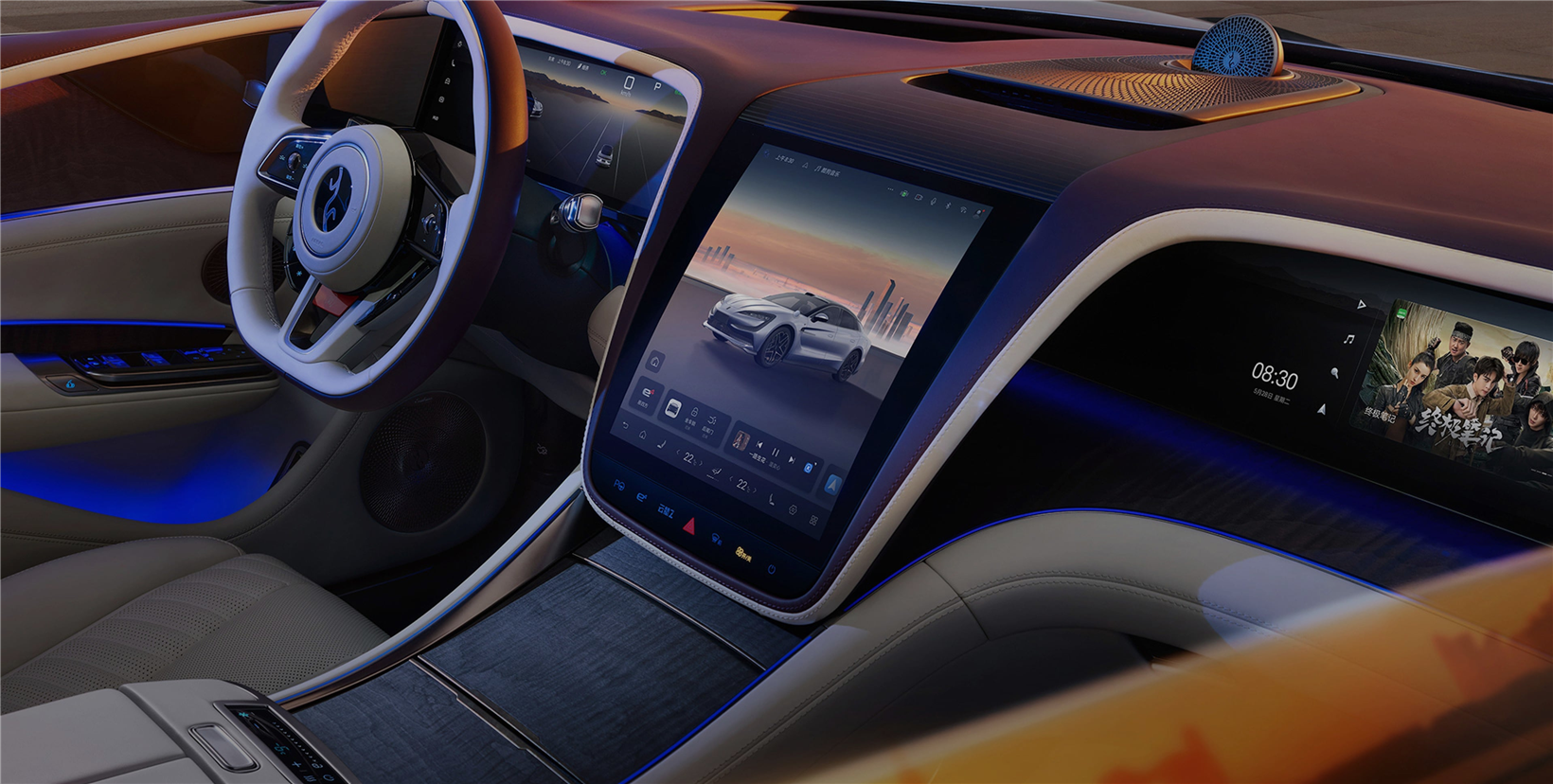
Inside, the U7 feels unashamedly expensive. There is Nappa leather sourced from Bavaria, real wood veneers, and a mix of soft‑touch materials that aim squarely at German luxury benchmarks.
Front seats offer 20‑way adjustment with 16‑point massage, ventilation, and heating. In the 4‑seat executive layout, the rear passengers get lounge chairs with deep recline, leg rests, and dual 12.8‑inch OLED entertainment screens, plus folding tables, small refrigerators, and temperature‑sensing armrests.
The driver faces a 23.6‑inch 3D digital cluster, supplemented by more 12.8‑inch OLED displays for infotainment. Audio is handled by a Dynaudio 23‑speaker Platinum system that would not be out of place in a high‑end home setup.
Opting for the 5‑seat version trades some of the individual rear luxuries for a more traditional rear bench and a more family‑oriented layout, which might suit buyers planning to use the car as an everyday family sedan rather than a chauffeured office.
God's Eye A / DiPilot 600 ADAS
On the driver‑assist front, the U7 combines:
- 3 LiDAR units
- 5 mmWave radars
- 13 cameras
- 12 ultrasonic sensors
- Dual Nvidia Orin‑X chips, delivering 508 TOPS of computing power
That hardware stack underpins what BYD calls L2+ autonomy, which in practical terms means hands‑free highway assist within defined areas, automatic emergency braking up to 120 km/h, and context‑aware integration between DiSus‑Z suspension and the ADAS system. On rougher stretches, the car softens its responses; in high‑speed evasive maneuvers, it firms up instantly.
BYD Yangwang U7 Price and Value Comparison
Pricing in China and AED
Official Chinese pricing slots the U7 in the upper end of the local luxury segment:
- 628,000–708,000 CNY, which works out to roughly 320,000–360,000 AED, using an exchange rate of 1 CNY = 0.51 AED.
| Trim | CNY | AED estimate |
|---|---|---|
| BEV base | 628,000 CNY | 320,000 AED |
| PHEV top | 708,000 CNY | 360,000 AED |
Also read: Top 10 Best Used Cars Dubai 2026
Versus Rivals: Cost per Horsepower and Range
Stacked against the usual suspects, the U7 offers a brutal cost‑per‑horsepower story:
| Model | HP | Price (AED, est.) | Cost per hp (AED) |
|---|---|---|---|
| Yangwang U7 | 1,287 hp | 320,000 AED | ~248 AED/hp |
| Lucid Air Sapphire | 1,234 hp | 1,200,000+ AED | ~972 AED/hp |
| Tesla Model S Plaid | 1,020 hp | 380,000 AED | ~373 AED/hp |
| Mercedes EQS | 751 hp | 550,000 AED | ~732 AED/hp |
The Lucid remains the range and luxury benchmark for many buyers, and the Plaid still dominates YouTube drag races. On sheer value for power and range, though, the U7 walks in at a much lower AED number while offering a more indulgent rear cabin than Tesla and higher claimed range than most of the field.
Availability and Ownership in UAE / Middle East
Release Outside China
Production is centered at BYD plants in China, with local deliveries having started in June 2025. For the Middle East, a regional launch is targeted for early 2026, likely through partners such as Al‑Futtaim Electric Mobility.
Before official launch, some units are expected to arrive as grey imports, with prices rumored to start around 300,000+ AED. Grey import routes can be tempting on price or timing but usually mean more complicated aftersales, patchy software support, and longer wait times for rare parts.
Servicing options will lean on the growing BYD footprint in the UAE, including official or authorized facilities in Dubai (DIP), Abu Dhabi (Umm Al Nar) and Sharjah, supplemented by specialist EV workshops such as EVS in Dubai, Abu Dhabi, and Ajman.
GCC Ownership: Charging and Total Cost of Ownership
For charging, the U7 will plug straight into the DEWA and NEWA public networks, with home AC wallboxes handling most day‑to‑day needs. Given the battery size, a properly installed 11–22 kW home charger is almost a necessity rather than a luxury.
In Gulf climates, LFP chemistry pays off. BYD’s Blade packs have shown roughly 10% less degradation than equivalent NCM cells across high‑heat cycles, which matters when daily temperatures hit 40°C for months.
Running costs look favorable compared to large petrol V8 sedans and even some rival EVs. There are no oil changes, far fewer moving parts, and less mechanical wear. Maintenance estimates of roughly 2,000 AED per year are common for Chinese‑market projections, especially when bundled with 5‑year / 100,000 km style service plans, which can cut ownership costs by around 45% versus typical European luxury sedans over the same period.
Conclusion
The Yangwang U7 arrives with a spec sheet that reads almost like a concept car: 1,287 hp, up to 1,006 km claimed CLTC range, and a starting price of around 320,000 AED in its home market. For buyers in the UAE and wider GCC who want to mix chauffeur‑grade comfort with supercar acceleration and low running costs, it is a very serious alternative to the usual German or American badges.
Summary Table
| Aspect | Details |
|---|---|
| Model name & trims | BYD Yangwang U7 BEV 150 kWh / PHEV |
| Starting price | 320,000 AED (estimated China base, converted) |
| Powertrain | Quad‑motor e4 AWD, 960–1,000 kW (1,287–1,341 hp), 1,584 Nm |
| Transmission & drivetrain | Single‑speed, AWD with rear‑wheel steering |
| 0–60 mph | ~2.7 s (extrapolated from 2.9 s 0–100 km/h) |
| Efficiency & range | 17.7 kWh/100 km CLTC; up to 1,006 km CLTC (BEV 150 kWh) |
| Interior highlights | Nappa leather, 20‑way massage seats, 23.6‑inch cluster, 12.8‑inch OLED display, Dynaudio 23‑speaker system |
| Exterior highlights | 0.195 Cd drag coefficient, Galaxy Blue paint, 21‑inch wheels |
| Safety & ADAS | God’s Eye A, 3 LiDARs, L2+ functions, DiSus‑Z suspension |
| Cargo space | Not officially specified, estimated 500+ L combined frunk + trunk |
| Warranty & maintenance | BYD‑backed service network where officially sold; added risk on grey imports |
| Release & availability | China deliveries from June 2025; Middle East rollout targeted early 2026 |
People Also Ask
What is the BYD Yangwang U7 and how is it positioned?
It is an ultra‑luxury electric sedan designed to rival cars like the Lucid Air and Mercedes EQS, with headline numbers of 1,287 hp and up to 1,006 km claimed range.
How much horsepower does it have, and how does performance compare with Lucid Air or Tesla Plaid?
The U7 delivers 1,287 hp and an official 2.9 s 0–100 km/h time. That matches Tesla Model S Plaid on acceleration and beats it on claimed range, while undercutting the Lucid Air Sapphire on price.
What are the key differences between the BEV and PHEV versions?
The BEV uses up to a 150 kWh battery with a 1,006 km CLTC rating. The PHEV pairs a 52.4 kWh pack with a 2.0L range‑extender for about 200 km electric‑only driving and more than 1,000 km overall range.
What should I know about the Blade Battery and DiSus‑Z suspension?
The U7’s 150 kWh LFP Blade Battery 2.0 focuses on safety and longevity, with high energy density and 800V fast charging. DiSus‑Z can adjust suspension settings 1,000 times per second and even stabilize the car after a tire blowout, keeping it controllable at up to 80 km/h for around 30 km.
Will the U7 be available in the UAE and wider Middle East?
Yes, regional rollout is planned for early 2026, with official imports expected through established distributors and access to DEWA/NEWA charging networks.
Where can I find luxury cars with verified service histories in the UAE?
Alba Cars offers luxury cars with verified service histories.
Did you find this article helpful?
Related Articles

2027 Nissan Elgrand: Specs, Price & e-POWER Luxury Minivan G...
Explore the 2027 Nissan Elgrand e-POWER: UAE price, specs, VIP lounge cabin, fue...
10/14/26
Deepal L07 UAE: Price, Range, Specs & Real-World GCC Verdict
Explore Deepal L07 UAE price, real GCC range, Huawei tech features and how it st...
10/13/26
Geely Galaxy E5 UAE Guide: Range, Price, Specs & Real-World ...
Explore Geely Galaxy E5 UAE price, range, specs and real-world ownership costs i...
10/12/26


Visit ALBA CARS - No.1 Used Car Showroom Dubai
Alba Cars Dubai Showroom
Showroom 17, 18 & 20, Al Asayel Street, Al Quoz Ind 1
Dubai, United Arab Emirates
